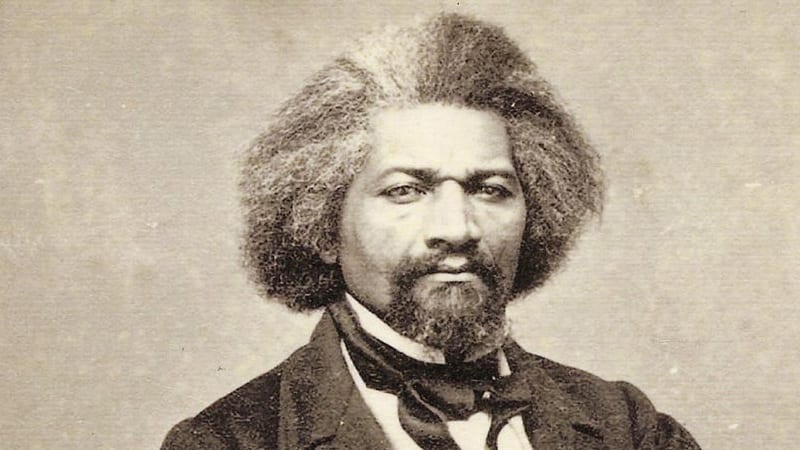
Frederick Douglass, the Fourth of July, and the Contradiction That Has Never Been Resolved
By Eric Lawrence Frazier, MBA
The Man and the Moment
On July 5, 1852, a man stood before an audience of approximately 600 people in Corinthian Hall in Rochester, New York, and delivered an address that remains, 174 years later, the most precise and most devastating examination of the American contradiction ever spoken from an American stage.1 The man was Frederick Douglass. The occasion was an Independence Day celebration organized by the Rochester Ladies’ Anti-Slavery Society. The audience was predominantly white, predominantly abolitionist, and had gathered because they considered Douglass one of the most powerful voices in the movement they shared.
They were not prepared for what he said.
Douglass did not thank them for their advocacy. He did not celebrate the progress that had been made. He did not offer the comfort of a movement united behind a common cause. He stood before that audience and held up a mirror. What the mirror showed was a nation that had written the most eloquent statement of human equality in the modern world and then spent seventy-six years constructing an elaborate legal, theological, and social apparatus to ensure that statement applied to as few people as possible.
The speech Douglass delivered that day is known for its central question. But the question is not the argument. The argument is the structure Douglass built around the question — the legal reasoning, the constitutional analysis, the theological indictment, and the moral framework that together produced something that no one in that hall, and no one since, has been able to honestly refute. Understanding what Douglass actually argued that day — as opposed to the single sentence most often quoted — is the purpose of this essay.
But before we can understand what he argued, we need to understand who was arguing it. Because Frederick Douglass was not speaking from an ivory tower, pontificating about principles he had studied in books. He was speaking from a life. And that life — the specific details of how it was lived, what it cost, and what it produced — is the foundation on which everything he said rests.
The Life Behind the Argument
Frederick Douglass was born into slavery in Talbot County, Maryland, in approximately 1818.2 He did not know the exact date of his birth. Enslaved people were not given that information. He was separated from his mother, Harriet Bailey, in infancy — a common practice on Maryland plantations, designed to prevent the formation of maternal bonds that might complicate the management of the enslaved workforce. He saw her only a handful of times before her death when he was approximately seven years old. He was not permitted to grieve her.
He taught himself to read. The precise mechanics of how he accomplished this — trading bread for reading lessons with white boys in the neighborhood, studying discarded newspapers, practicing letters in the dirt — are documented in his first autobiography, published in 1845 when he was approximately twenty-seven years old.3 The act of literacy was not merely an intellectual achievement. It was a criminal one. Maryland law made it illegal to teach an enslaved person to read or write. The punishment was severe. Douglass understood this and proceeded anyway. That decision — to acquire, in secret and at considerable personal risk, the very tool that the system had determined he must never possess — tells you everything essential about the man before he has said a public word.
He escaped slavery in 1838, at approximately twenty years of age, traveling north by train and steamboat using borrowed identification papers.4 He settled in New Bedford, Massachusetts, found work as a laborer, and within three years had become one of the most sought-after speakers in the abolitionist movement — a movement dominated by white intellectuals who had spent their careers arguing for the humanity of Black people and who now found themselves sharing a platform with a Black man whose command of language, logic, and moral argument exceeded their own.
This is the first thing to understand about Frederick Douglass: he did not arrive at his intellectual authority through privilege or institutional support. He arrived at it by teaching himself, escaping a system designed to prevent his escape, and building — from nothing, from the scraps of opportunity that a hostile society made available to a formerly enslaved Black man in the 1840s — a platform, a newspaper, a body of writing, and an international reputation that made him the most photographed American of the nineteenth century.5 He is not a symbol of what Black people can achieve when given the right opportunities. He is the argument that no system of oppression, however comprehensive, can fully contain what a determined human being will build from whatever opening presents itself.
He pulled himself up without boots. That is the point. The bootstraps argument, as it has been co-opted by those who wish to deny the reality of structural racism, imagines Douglass pointing down from a position of comfort and telling Black people to try harder. That is not what Douglass said,d and it is not who Douglass was. Douglass was a man speaking from the mud, telling the people still in it: I know exactly where you are because I was there. And I am telling you — not as a comfort but as a demand — that you have more power than they have told you. The system wants you to believe you have nothing. The act of believing them is the first and most important victory they can take from you. Do not give it to them.
That is the Douglass who stood in Corinthian Hall on July 5, 1852. Not a comfortable man. Not a safe man. A man who had lived inside the apparatus this series is documenting and had emerged from it not diminished but forged. The speech he gave that day was not the product of reading about slavery. It was the product of having survived it.
The Parallel Timeline
To understand what Douglass was saying, you must first hold two timelines simultaneously. The first is the timeline of American founding mythology. The second is the timeline of Black American reality. They run parallel to each other, in the same years and on the same soil, and they have almost nothing in common.
In 1776, the Continental Congress adopted the Declaration of Independence, establishing as a self-evident truth that all men are created equal and endowed by their Creator with certain unalienable rights, among which are life, liberty, and the pursuit of happiness.6 In 1776, approximately 500,000 enslaved Black people lived in the thirteen colonies.7 They were not included in the self-evident truth. This was not an oversight. It was a decision.
In 1787, the Constitutional Convention produced the document that would govern the new nation. The Constitution contained three provisions that directly concerned the enslaved population. The three-fifths clause counted enslaved people as three-fifths of a person for purposes of Congressional apportionment — not to extend them representation, but to extend theienslavers’rs political power proportional to the number of people they owned.8 The fugitive slave clause required that escaped enslaved people be returned to their enslavers even if they had reached free states.9 And the international slave trade was protected from Congressional interference until 1808.10 The founders were not men who had not thought about slavery. They were men who had thought about it carefully and made a series of deliberate choices that preserved and extended it in exchange for the political unity of the new nation.
In 1820, the Missouri Compromise established the principle that the expansion of slavery into new territories was a negotiable political question — a matter of legislative compromise rather than moral reckoning.11 In 1850, the Compromise of 1850 strengthened the Fugitive Slave Act, requiring not just the return of escaped enslaved people but the active participation of Northern citizens in their capture.12 In 1852, the year Douglass gave his speech, approximately 3.2 million Black people were enslaved in the United States.13 They had built the economy that was generating the prosperity that the nation was celebrating on the Fourth of July. They were not invited to the celebration.
This is the parallel timeline. On one track: the rhetoric of liberty, the celebration of independence, the declared belief in human equality as a God-given and self-evident truth. On the other track: the legal apparatus of bondage, the deliberate exclusion of Black people from the principles being celebrated, and the active use of state power to maintain that exclusion against every attempt to challenge it.
Douglass did not invent this contradiction. He named it. With a precision that 174 years have not diminished.
What Douglass Actually Argued
The most famous sentence from the July 5th address is the question: What to the American slave is your Fourth of July?14 That question is cited so often, in so many contexts, that it has acquired a kind of rhetorical familiarity that has blunted its force. People quote it as though it is primarily an emotional appeal — a cry of pain, an expression of exclusion. It is not. It is the conclusion of a legal and moral argument of extraordinary sophistication, and it cannot be understood without the argument that precedes it.
Douglass began the speech not with accusation but with agreement. He spent the first substantial portion of the address praising the founders — genuinely, not sarcastically. He argued that the men who signed the Declaration of Independence were great men who established great principles.15 He said that the document they produced was the ringbolt to the chain of the nation’s destiny. He meant it. He was not being ironic. He was establishing, with full deliberateness, that the principles of the founding were sound — that the argument for human equality and unalienable rights was correct — because what followed depended entirely on that establishment.
Then he turned.
If the principles are sound — if it is in fact a self-evident truth that all men are created equal and endowed with unalienable rights — then the institution of slavery is not merely cruel. It is a direct and unambiguous violation of the nation’s own stated foundations. You cannot hold these truths to be self-evident and simultaneously hold human beings as property. The contradiction is not an accident of history. It is not a failure of implementation. It is a deliberate choice that the nation made and has continued to make, generation after generation, in the face of its own declared principles.
This is what Douglass said. And then he asked his question. Not as a cry of pain. As the logical conclusion of the argument he had just constructed. What, to the American slave, is your Fourth of July? It is a day that reveals, more than all other days in the year, the gross injustice and cruelty to which he is the constant victim. To him, your celebration is a sham, your boasted liberty an unholy license, your national greatness swelling vanity.16
The audience in Corinthian Hall was silent.
Because Douglass had not attacked their patriotism. He had held their patriotism up to the standard it claimed for itself and shown them, with the precision of a man who had spent his life studying the document that was supposed to guarantee his freedom, exactly where it fell short. He was not the enemy of the Republic. He was its most demanding creditor.
The Strategist Behind the Orator
The conventional account of Frederick Douglass’s intellectual development presents his early agreement with William Lloyd Garrison as a position he later outgrew — a young man who believed the Constitution was irredeemably proslavery and then, through study and reflection, arrived at the more sophisticated understanding that it was, in fact,t an antislavery document. This is a comfortable story. It is almost certainly wrong. Not because Douglass lacked the capacity for intellectual growth, but because it misunderstands who Douglass was and what kind of mind he brought to every room he ever entered.
Garrison was not simply a mentor. He was the most powerful figure in the abolitionist movement, and his network was the infrastructure through which Douglass reached audiences. But here is the fuller truth: Douglass had to navigate his way through every expectation placed on him — from his own community, from the white abolitionist community, from a society that had decided in advance what kind of man he was allowed to be. To have an audience, he needed to be received. To be received, he had to manage his language, manage his positions, and manage the image he projected to people who held the platforms and the safety that his reach depended on. This navigation was not a weakness. It was sophisticated political intelligence operating under conditions that most people who have analyzed him from the comfort of a later century have never had to face. You do not tell the man who controls your platform what you actually think of the document he has staked his movement on — not until you have built your own platform and no longer need his.17 His network was the infrastructure through which Douglass reached audiences. His endorsement was the credential that made Douglass credible to white abolitionist audiences who might otherwise have dismissed a formerly enslaved man’s claims about his own experience. Douglass needed Garrison’s platform. And Garrison’s platform came with Garrison’s theology — including the position that the Constitution was a covenant with death and an agreement with hell, as Garrison famously described it, because it accommodated slavery.
Think about what he was navigating. A singular Black man — self-educated, escaped from slavery, standing in rooms full of white intellectuals who controlled the only audiences available to him — who was also one of the most gifted constitutional thinkers of his century. He was at the mercy, in the most literal sense, of people whose goodwill he needed and whose positions he could not afford to publicly challenge. Up to the point where he had built his own independent standing, he was constrained by the fear of what disagreement might cost him — not just professionally but physically. This was not a theoretical concern. This was the specific reality of being a Black man in antebellum America who was well known enough to be targeted and not yet powerful enough to be fully protected. The navigation was survival. And the documentary evidence for its strategic nature is not in a private letter or a diary entry that critics can demand to see. It is embedded in the arc of his public life itself.
He founded The North Star in 1847 — his own newspaper, his own platform, his own audience, his own independent standing.18 Within four years, he had publicly broken with Garrison and declared the Constitution an antislavery document. The timing is not coincidental. A man does not spend years in agreement with a position and then change his mind the moment he no longer needs the person who holds that position. That is not intellectual development. That isa strategy. And in Douglass’s circumstances — as a Black man whose safety, reach, and credibility depended entirely on the goodwill of white allies — strategy was not a moral compromise. It was survival.
Within four years of founding The North Star, he publicly declared the Constitution an antislavery document. The critics who demand documentary evidence of his private calculation have missed the point entirely. The documentation is his life. The evidence is the timing. A man does not spend years publicly agreeing with a position and then change his mind the moment he no longer needs the person who holds it. That is not intellectual development. That is a man who has finally arrived at the place where he can speak boldly — without the constraints of White expectation, without the fear of what public disagreement might cost him, without the requirement to manage himself into acceptability before he could be heard. The July 5th address was not a speech that emerged from an epiphany in the years following his break with Garrison. It was the culmination of a lifetime of witness, of navigation, of strategic positioning, of a man who had been building toward one moment of complete and unguarded truth. Everything before 1852 was the preparation. The address itself was the arrival. That is the Frederick Douglass we know. Everything else was the long and disciplined road to get there. And that road — the navigation, the compromise, the calculation, the patience of a man who knew exactly what he was doing and waited until he had the ground to do it — is not a diminishment of his greatness. It is the full measure of it.
The Theological Indictment
The July 5th address did not end with the constitutional argument. Douglass turned, in the latter portion of the speech, to the Christianity that was being used to justify the institution he was indicting. What he said there is as relevant today as it was in 1852 — and it leads directly into the territory this series examines in Part Four.
Douglass was not anti-Christian. He was anti-hypocrisy. He drew an explicit distinction in the speech between the pure, peaceable, and impartial Christianity of Christ and what he called the corrupt, slaveholding, women-whipping, cradle-plundering, partial and hypocritical Christianity of this land.19 He was not attacking the faith. He was attacking the use of the faith. He was naming precisely what this series documented in Part Two — that the same text, read by different people in different circumstances, produces radically different Gods. The God of the plantation pulpit was not the God of the enslaved congregation. They were reading the same Bible. They were finding completely different revelations in it.
Douglass understood something that the theological establishment of his time was not prepared to acknowledge: that the Christianity being practiced in the slaveholding South was not a corruption of the faith that might be reformed. It was a fully developed theological system with its own internal logic, its own scriptural justifications, and its own God — a God who had ordained the subordination of Black people and whose authority was being invoked to maintain it. You could not argue with that system from within its own premises, because its premises were designed to foreclose argument. What you could do — what Douglass did — was expose it from the outside, by holding it up against the principles it claimed as its foundation and showing where it failed them.
He was doing to American Christianity exactly what he had done to American democracy: holding up a mirror.
The questions that mirror raises — about the God who was handed to enslaved African people as a tool of psychological control, about what was lost when the spiritual traditions of the African continent were suppressed, about what the Black church found in scripture that its oppressors had not put there and could not take back — those questions do not have simple answers. They are the questions this series will continue to examine in Part Four and beyond. But Douglass named them first. Standing in Rochester in 1852, with three million people still in chains, he named them with the clarity of a man who had nothing left to lose by telling the truth and everything to gain by telling it precisely.
Self-Determination: What Douglass Actually Meant
There is a version of Frederick Douglass that has been constructed by people who need him to mean something he never said. In this version, Douglass is the nineteenth-century prophet of individual responsibility — the man who pulled himself up by his bootstraps and told Black people to stop blaming the system and start taking personal accountability. This version of Douglass is cited regularly by commentators who wish to argue that structural racism is either exaggerated or irrelevant, and that the condition of Black America is primarily a product of individual choices rather than documented historical policy.
This version of Douglass is false. And it is an insult to the man it claims to invoke.
Frederick Douglass was not speaking from an ivory tower, pontificating about his success and speaking down to anyone. He was a man speaking about what he knew intimately — having been born into slavery and having had to pull himself up without any boots at all. If anything, the argument he was making was the reverse of the one attributed to him: at least you have bootstraps to pull. I did not have any. And I am still here.
What Douglass was arguing — in his speeches, his newspaper, his autobiographies, his entire public life — was not that Black people should accept the conditions imposed on them and work harder within those conditions. He was arguing the opposite. He argued that the system was designed to exclude and that the response to exclusion was not petition and not patience. It was construction. Build what you are being denied. Educate yourself when they refuse to educate you. Establish institutions when they refuse to include you in theirs. Demand equal access and simultaneously create the structures that do not depend on anyone granting it.
His bootstraps argument is a call to every man, woman, and child — regardless of race, although he was speaking to Black America — to understand that failure is not an option. That you will do whatever you have to do, learn whatever you have to learn, fight whatever you have to fight. That you will take care of yourself and your family and be the person you have been divinely called to be — the leader in your family, the provider for your community, the full expression of the gifts and talents you were endowed with at creation. That your life is not your own in the sense that it is not merely personal. You are the breath of God manifest on this earth, revealed to the world, contributing what you were made to contribute. To surrender that contribution to a system that has decided you have nothing to offer is humility. It is betrayal — of yourself and of every person who will never receive what only you were made to give.
That is what Douglass meant. The people who cite him to argue against structural accountability have not read him. They have read a sentence extracted from a body of work they have not engaged with and used it to make an argument he spent his entire life contradicting.
Douglass fought simultaneously on two fronts his entire career. He demanded that America live up to its own stated principles — equal protection, equal access, equal standing under the law. And he built, in parallel, the institutions that would not wait for America to comply. The North Star. The Rochester station of the Underground Railroad, which he operated personally.20 The campaign for Black male suffrage in New York. The recruitment of Black soldiers for the Union Army. The advocacy for Black education at every level. He did not choose between demanding equality and building independence. He understood that a people who can only survive on the goodwill of those with power over them are not yet free, regardless of what the law says. Real freedom is the capacity to sustain yourself, whether or not anyone else decides to help you.
That is the Douglass this series is documenting. Not the symbol. The man. The strategist. The builder. The person who understood, from the specific experience of his own life, that self-determination is not a consolation prize for people who have been excluded from the system. It is the only foundation on which anything permanent can be built.
The Mirror Is Still There
The Reconstruction Amendments — the Thirteenth, Fourteenth, and Fifteenth — were ratified between 1865 and 1870. They abolished slavery, established birthright citizenship and equal protection under the law, and prohibited the denial of voting rights based on race.21 By 1877, Reconstruction had effectively ended. The federal government withdrew from the South. The Redeemers moved in. The mechanisms of exclusion were rebuilt under new names: Black Codes, vagrancy laws, convict leasing, poll taxes, grandfather clauses, literacy tests, and the organized terror of the Ku Klux Klan operating with the tacit permission of state governments.22 The constitutional amendments that had promised equality were interpreted into irrelevance by a Supreme Court that, in the Civil Rights Cases of 1883, ruled that the Fourteenth Amendment prohibited state discrimination but not private discrimination — effectively gutting the Civil Rights Act of 1875 and leaving Black Americans legally exposed to exactly the conditions that act had been designed to prevent.
Douglass was alive for all of this. He had predicted it. In his 1865 address at the end of the Civil War, he had warned that legal freedom without economic foundation, without the ballot, without equal protection in practice rather than just in principle, was not freedom. It was a different arrangement of the same condition.23 He was right within a decade.
The mirror Douglass held up in Rochester in 1852 has not been put down. The nation has not looked into it fully. It has looked at portions of what the mirror shows — it has acknowledged slavery as a historical wrong, it has erected monuments to the abolitionists, it has installed a federal holiday in the name of Martin Luther King Jr, while continuing to avert its eyes from the specific, documented, ongoing consequences of the decisions that are reflected there. The wealth gap. The incarceration disparity. The education funding differential. The health outcome gap. The housing discrimination that continued in practice long after it was prohibited in law. These are not the residue of a distant past. They are the current account balance of decisions documented in the historical record that this series is examining.
Frederick Douglass did not ask what the Fourth of July means to the enslaved so that white Americans would feel guilty. He asked so that they would look. So that they would hold the principles they celebrated against the reality they were maintaining and account for the distance between them. He was not asking for sympathy. He was demanding honesty. The same honesty this series is demanding — not from white America specifically, but from every reader who is willing to hold the full record in both hands and draw the conclusions it requires.
Part Four of this series examines the theological architecture that made it possible for a Christian nation to build and maintain the institution that Douglass indicted. The Bible and the Whip. How the same text that the Black church transformed into a liberation document was used by the people who handed it to enslaved Africans as a tool of psychological subjugation. And what does this mean to the transformationthat happened anyway?.
The mirror is still there. It has always been there. The question is not whether we are willing to look. The question is whether, having looked, we are willing to account for what we see.
Subscribe to The Power Is Now TV to connect with me live every weekday, Monday through Friday, from 10:00 AM to 11:00 AM PST, as we record television shows across the Power Is Now TV Network. As a subscriber, you can participate in live tapings, engage in real-time discussions, and connect directly with industry leaders.
Visit ThePowerIsNow.com to access real estate magazines, books, podcasts, television shows, and exclusive media content focused on homeownership, business, and wealth-building.
For personalized support, consulting, and advisory services in real estate, mortgages, business, and personal finance, visit EricFrazier.com to schedule a consultation and learn more about my work as your trusted advisor in business and wealth.
Eric Lawrence Frazier, MBA
Your trusted advisor in business and wealth
www.ericfrazier.com | www.ericfrazieruk.com
NMLS #451807 | CA DRE #01143484
Schedule a consultation: https://calendly.com/ericfrazier/real-estate-mortgage-consultation-clients
