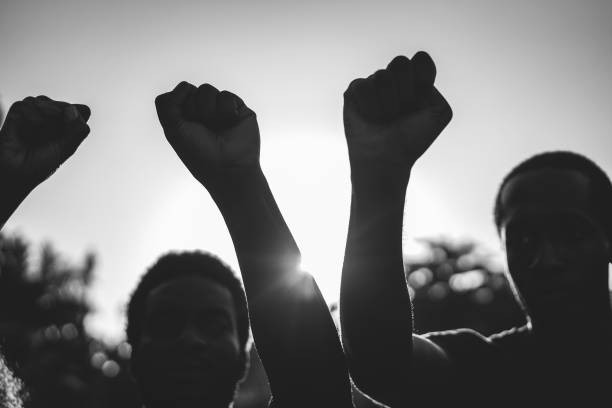
The Celebration and the Reckoning
By Eric Lawrence Frazier, MBA
Welcome to Part Ten — the final essay of a ten-part series. We begin with The Crossing. The laboratory of race science. The navigation strategies of Frederick Douglass. The theological weapon of the slaveholder’s Bible. The systematic destruction of Reconstruction. The federal architecture of the racial wealth gap. What they built anyway. The racial calculation behind every policy this nation has ever called something else. The industry that spent a hundred and sixty years trying to make sure no one would ever understand or learn the truth about our story in this country.
The series began with a question it did not immediately answer. Part One asked what it means that a people survived the Middle Passage and arrived — not broken, not emptied, but carrying something that the ocean could not take and the auction block could not price. Nine essays later, the question has not changed. What it means is the work of this essay.
The answer is not political. The record has established that political systems failed Black America with a consistency that cannot be attributed to oversight. The answer is not economic. The record has established that the racial wealth gap was not an accident of the market but a product of deliberate federal policy. The answer is philosophical. And it was present before the first ship left the coast of West Africa.
The Return to Origin
The African spiritual traditions that survived the Middle Passage did not survive because they were hidden. They survived because they were woven into the fabric of daily life so completely that they could not be separated from the people who carried them. The slaveholder could take the language. He could take the name. He could take the family structure, the homeland, the drums. What he could not take was the understanding of what a human being is — and that understanding, carried across the water in the bodies of the people themselves, was the foundation on which everything else was rebuilt.
Across the West and Central African spiritual traditions that fed the slave trade — Yoruba, Akan, Bakongo, Igbo, Fon — a consistent philosophical framework appears. The framework holds that the human being is not the body. The body is the vessel. The person — the animating force, the identity, the moral weight of a human life — exists independently of the physical form that houses it. Death is not termination. It is a transition. And the ancestors who have made that transition remain present, remain available, remain engaged with the living who carry their names and continue their work.1
This is not superstition. It is a philosophical position about the nature of personhood — one that has parallels in traditions from ancient Egypt to the Stoics to the Christian mystical tradition —, and it carried a specific practical consequence for the people who held it under the conditions of American slavery. If you are not your body, then what is done to your body does not reach the deepest part of what you are. The whip reaches the body. It does not reach the person.
The Bakongo cosmogram — the dikenga — depicts the human soul moving in a continuous circle through the living world and the world of the ancestors, with the water as the boundary between the two states of being. Enslaved Africans brought to the Americas recognized the Atlantic Ocean within that cosmological framework. The crossing was not only geographic. It was spiritual — a passage through the waters that connected the world of the living to the world of those who had gone before. The ancestors were on both sides of the water. They had not been left behind.2
The spirituals encoded this understanding in language the slaveholder could hear without comprehending. “Swing Low, Sweet Chariot” was understood by slave owners as a song about Christian salvation — the chariot that carries the soul through the transition that the body cannot make on its own. “Wade in the Water” was understood as a baptism song. It was also, practically, an escape route instruction: enter the water to break the scent trail from the dogs. The spiritual tradition was never only spiritual. It was operational.
The Philosophical Foundation
The theology imposed on enslaved people by the slaveholder was a theology of submission. God was above. God had ordained the social order. Obedience to the master was obedience to God. The enslaved person was to find comfort in the promise of a justice that would be delivered after death, in a kingdom not of this world, to a soul that had demonstrated its worthiness through patience with its suffering. This theology served the slaveholder perfectly. It was also, in its essentials, a lie.
The African spiritual inheritance understood God differently — not as an external authority dispensing judgment from above, but as the animating force within all living things. The divine was not separate from the human. It was the deepest expression of what the human being already was. This is not a marginal theological position. It is present in the mystical traditions of virtually every major world religion — in Sufi Islam, in Kabbalistic Judaism, in Christian mysticism from Meister Eckhart to Howard Thurman. It is the understanding that the encounter with the sacred is not an encounter with something outside the self but a recognition of what was always within it.
Howard Thurman, the theologian whose work directly shaped the philosophical framework of the civil rights movement, wrote in Jesus and the Disinherited that the religion of Jesus was a religion developed among a dispossessed people — and that its core message was not about the afterlife but about the irreducible worth of the person standing in front of you right now, in this life, under these conditions, regardless of what any external authority has declared about their value. Thurman was the grandson of an enslaved woman. He understood that the theological question and the political question were the same question.4
The freedom songs of the civil rights movement were not asking God to intervene from above. They were declarations of a dignity that already existed — that had always existed — and that no law, no custom, no economic arrangement, and no act of violence had the power to negate. “We shall overcome” is not a petition. It is a statement of fact about the nature of the person singing it. The philosophical foundation was the African ancestor tradition, transmitted through the spirituals, refined by the Black church, and articulated by theologians who understood that the most radical political act available to a dispossessed people is the insistence on their own sacredness.
The Reckoning
The United States has never been held accountable for what this series has documented. Not for the two hundred and forty-six years of chattel slavery, whose accumulated unpaid labor economists have estimated in the trillions of dollars. Not for the deliberate destruction of Reconstruction and the century of legal apartheid that followed it. Not for the federal housing policy that built the racial wealth gap into the geography of every American city. Not for the War on Drugs, whose architects have confessed in print to its racial intent. Not for the congressional legislation whose racial arithmetic was visible before the votes were cast. Not for the executive orders signed in January 2025 that dismantled sixty years of civil rights infrastructure in a single day. What accountability would require is not complicated: it would require telling the truth in the places where the lies were told, and making whole what the lies made broken. That has not happened. This essay does not wait for it.5
The Celebration
Part Seven of this series documented the achievement record. The inventions, the institutions, the art forms, the intellectual traditions, the cultural productions that Black Americans generated under conditions specifically designed to prevent their generation. That record stands on its own. It does not need repetition here.
What this essay celebrates is not the achievement. It is the spirit that produced it. And those are not the same thing.
The Harlem Renaissance did not occur because conditions for Black artists in America had improved. It occurred between 1920 and the mid-1930s — during the height of Jim Crow, during the Klan revival that Birth of a Nation had helped produce, during the period when Dunning School mythology was the dominant academic framework for understanding the Black political past. Langston Hughes, Zora Neale Hurston, Claude McKay, Aaron Douglas, Duke Ellington — they did not wait for permission. They did not wait for conditions to improve. They created a cultural movement of such force that it reoriented world literature, visual art, and music while living inside a system designed to make them invisible.6
The same spirit produced the Black church as a complete institution — bank, school, community center, political organizing hub, and sanctuary — inside a society that refused to provide those services. It produced historically Black colleges and universities when the existing universities would not open their doors. It produced mutual aid societies, insurance companies, newspapers, and law firms when the established institutions of each profession were closed to Black practitioners.
None of this required that the suffering be minimized. The people who built these institutions were not unaware of what had been done to them. They were precisely aware. The celebration is not of the suffering. It is of the choice made in the presence of the suffering — the choice to build, to create, to transmit, to insist on the fullness of human life under conditions that declared that fullness impossible.
The jazz musician who developed an entirely new musical language in the aftermath of slavery was not simply talented. Talent is a gift distributed without regard to circumstance. What the jazz musician demonstrated was something the talent alone cannot explain: the capacity to take the instruments of one culture, the rhythmic memory of another, the grief of a specific historical experience, and the philosophical insistence on joy as an act of defiance — and to synthesize all of it into something the world had never heard. That is not an achievement. That is alchemy.
The Inheritance
The ancestor doctrine that survived the Middle Passage holds that the dead are not gone. They are present in the work that continues after them, in the names that carry their memory, in the philosophical tradition they transmitted to the generation that received it and will transmit it again. The inheritance is not metaphorical. It is as concrete as the institutions that still stand, the music that is still played, the scholarship that is still read, the legal strategy that is still deployed in courtrooms, arguing cases that Thurgood Marshall began.
Ida B. Wells documented lynching at a time when the documentation itself was an act of physical courage — when the men who committed the violence were the same men who enforced the law. She is present in every journalist who covered the current erasure campaign, who published the list of two hundred flagged words, who documented what disappeared from the federal websites before the disappearance could be denied. The work is continuous. The workers change. The ancestors remain.7
Carter G. Woodson founded Negro History Week because he understood that memory is not passive — that it requires active cultivation, that it will be lost if the people responsible for it do not treat it as a responsibility. He is present in every teacher who kept the record in a classroom after the federal websites were purged, in every archivist who documented the deletions, in every citizen who put a handmade sign on a fence in Philadelphia.
The inheritance passes in both directions. What the ancestors passed to this generation is not a set of achievements to be catalogued. It is a demonstrated capacity — proven under the most extreme conditions this country has been able to produce — to locate the source of human dignity inside the person, where it cannot be reached, and to build from that location outward into the world.
What this generation passes forward is the same thing, extended. The record, preserved. The institution is maintained. The philosophical understanding, named and transmitted with enough clarity that the generation that receives it does not have to discover it under crisis conditions. They can begin where this generation ends.
The Closing Argument
This series was written for the people it documents.
It is addressed to the person who has read all ten parts and is sitting with the weight of what the series has documented — who understands what was done and how deliberately it was done and how thoroughly the hiding of it was arranged. That weight is real. It is appropriate. It is the correct response to the correct understanding of a documented historical record.
And it is not the last word.
The last word belongs to the people who survived it. Who built jazz and the blues and gospel and hip-hop out of the materials of their suffering. Who built Howard University, Spelman, and Morehouse when the existing universities would not have them? Who built the NAACP Legal Defense Fund and argued Brown v. Board of Education before a Supreme Court that had spent decades working against them. Who marched in Birmingham and Selma, knowing what waited for them on the bridge. Who ran for office in jurisdictions that had spent a century trying to remove them from the rolls. Who documented the erasure campaign in real time while the erasure was happening?. Who put handmade signs on fences?
The last word belongs to the grandmother who raised her grandchildren in a neighborhood that federal housing policy built to contain them and who sent them out into the world with a standard of excellence that the neighborhood was designed to prevent. To the father who worked two jobs in an economy that had priced him out of the one job that would have been enough. To the student who learned the history that the curriculum withheld and who brought it back to the classroom and taught it anyway.
The last word belongs to the ancestors who crossed the water carrying something the ocean could not take — and who are present, still, in every act of building, every act of preservation, every act of insistence on the fullness of a human life that the system declared impossible.
They were never less.
Not for one day in four hundred years.
We can never forget. Because it could happen again.
